(1).jpg)
-
An ostrich eye is bigger than its brain.
Giraffes are unable to cough .
Only humans sleep on their backs.
TRIBUTE TO PHILLIP HUGHES


Michael Clarke remembers Phil Hughes Michael Clarke gives an emotional press conference paying tribute to his great mate Phil Hughes. This was so difficult for Michael.


AMAZING FACTS ABOUT BODY....
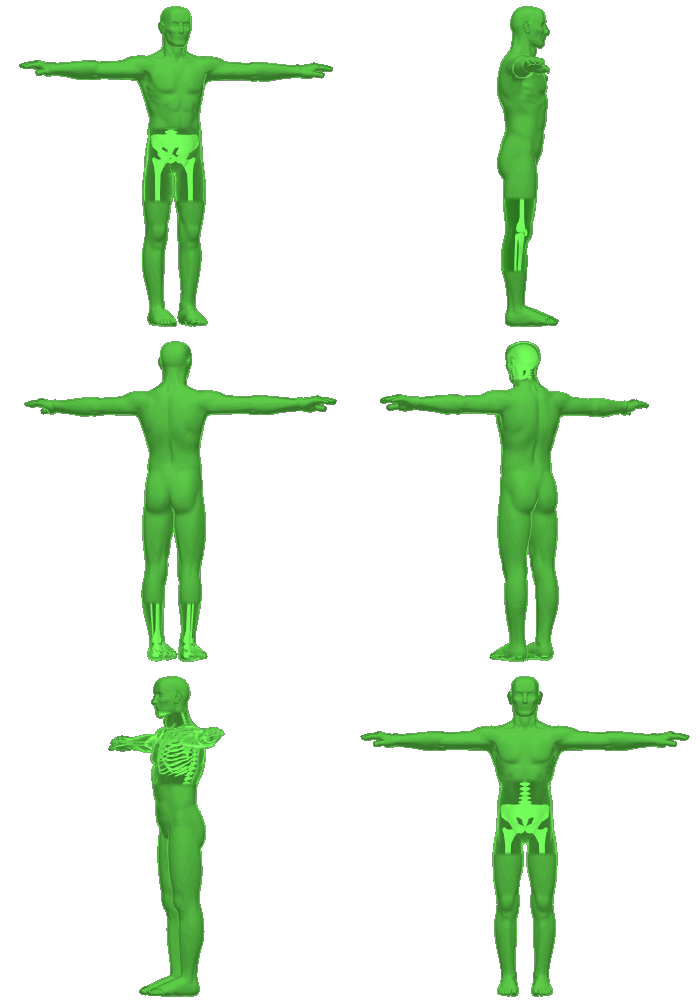 Did you than human nose can remember up to 50000 different types of scents .
- Research suggests that Children tend to grow faster in spring season as compared to any other time of the year !
- Do you know that on average,men have larger noses than women !
- Do you know that the enamel on the top surface of our tooth is the hardest part of the entire body !
- Food is either cooled or warmed to a suitable temperature in the mouth !
- Hugging releases oxytocin,which helps to heal physical wounds,makes someone trust you more !
- Do you know that your Toe-prints are also unique , just like your finger prints !And imagine even your tongue print is unique!
- You know ,you have no sense of smell when you're sleeping!
- You know ,you can see your nose all the time but somehow your brain always ignores it!
- We all blink after every few seconds, but do we know the purpose of blinking ! Blinking helps to wash tears over our eyeballs.That keeps them clean and moist.
- An average person has over 1,460 dreams a year which is about 4 dreams every night!
- On a clear night ,the human eye can see between 2000 to 3000 stars in the sky.
- Do you know the similarity between human body and a banana? You will be amazed to know that 50% of human DNA is same as in banana!
- The human body has enough iron in it to make 3 inches long nail.
- A human heart pumps enough blood to fill 100 swimming pools in an average lifetime.In the same time it will beat almost three billion times
- While sleeping, one person out of every eight snores, and one in ten grinds his teeth
- All babies are color blind when they are born ,so > they only see black & white.
- People with dark color skin wrinkle later than the people having light color skins!
- Guess how many muscles are working when you take a step! Well, about 200 muscles are used when we take a single step!
- Weight of the eyeball ! The eyeball of a human weighs approximately 28 grams.
- People generally read 25% slower from a computer screen compared to paper.
- Do you know ,it is impossible to sneeze with your eyes open !
- And do you know ,it is impossible to hum while your nose is plugged close !
- Do you know 'rhinoplasty' is the name given to plastic surgery which involves nose !
- Have you heard about Anosmia ,Dysosmia ,Hyperosmia? These all words are related to sense of smelling. Anosmia means inability to smell and Dysosmia is a condition where things don't smell like they should smell whereas Hyperosmia means strong sense of smelling !
- Here is one more trivia about nose :the technical term for sense of smell is 'olfaction' !
- Your brain is move active and thinks more at night than during the day.
- Here is an amazing fact about the brain,it uses 20% of the total oxygen and blood in your body.
- Do you know what is Uvula? It is the small piece of the small tissue dangling over the tongue.
- Now this is cool ,the tongue is the strongest muscle in the human body.
- And did you know that our fingers don't have any muscles ? The muscles which move our finger joints are located in the palm and up in the forearm.
- An adult human body contains approximately 100 trillion cells!
- Your tongue has 3,000 taste buds.
- Do you know ,your brain is 80% water?
- No pain in the brain! Do you know our brain does not feel pain! Even though brain processes pain signals,the brain itself actually does not feel pain.
- Bones in an adult account for 14% of the body's total weight.
- The tips of your fingers have enough strength to support the weight of your whole body
- When you are born with 300 bones in their body, but as an adult you only have 206 bones. This happens because many of them join together to make a single bone.
- The outsides of a bone are hard, they are light and soft inside. They are about 75% water.
- The strongest bone in your body is the femur (thighbone), and it's hollow!
- The smallest bone in the human body is the staples bone which is located in the ear,it is also called stirrup .
- Men get hiccups more often than women.
- A sneeze can exceed the speed of 100 miles per hour.When a sneeze leaves your body ,it is at such a high speed that you should avoid suppressing it.
- It takes food only seven seconds to go from the mouth to the stomach via the esophagus, pretty fast , right?
- Enamel is hardest substance in the human body.
- Fingernails grow nearly 4 times faster than toenails!
- Women hearts beat faster than men. Also women blink more than men !
- In one day ,your heart beats 100,000 times.

- The normal pulse is 70 heartbeats per minute.
- Blood is such a good stain that Native Americans used it for paint.
- Did you know that Blood is 6 times thicker than water?
- Our kidneys filter about 1.3 liters of blood every minute & expel up to 1.4 liters of urine in a day.
- The capacity of an adult human bladder ranges from approximately 600 ml to 800 ml. The exact maximum capacity varies from person to person. But remember that the urge to urinate is triggered when the bladder contains about 100 to 200 mls , much lower than full capacity. As the bladder fills with fluid, receptors in the bladder wall get stretched.
- Do you know a woman has approximately 4.5 liters of blood in her body, while men have 5.6 liters?
- Your blood takes a very long trip through your body. If you could stretch out all of a human's blood vessels, they would be about 60,000 miles long. That's enough to go around the world twice.
- Did you know that, our heart (which is one of the main muscles ) is so powerful that it can squirt the blood no less than 9 meters high? It's because it’s programmed to deliver the blood even in the less accessible areas of the body, like the toes & the fingertips, and therefore, in order to do this, it’s necessary for the heart to create lots of pressure inside the veins.
- People with darker skin will not wrinkle as fast as people with lighter skin.
- The reason honey is so easy to digest is that it’s already been digested by a bee.
- The only part of the body that has no blood supply is the cornea in the eye. It takes in oxygen directly from the air.
- The sound you hear when you crack your knuckles is actually the sound of nitrogen gas bubbles bursting.
- Women blink nearly twice as much as men.
- It takes about 20 seconds for a red blood cell to circle the whole body.
- Every drop of blood in your body is filtered by your body over 300 times a day.
- Babies are born with pink lungs but they darken in color as we breathe in polluted air.
- Your right lung is bigger than left lung! The left lung is small so as to adjust heart in that part !
- Human hair and fingernails continue to grow after death.
- You burn more calorie while sleeping than watching TV.
ROSE
 A rose is a woody perennial of the genus Rosa, within the family Rosaceae. There are over 100 species and thousands of cultivars. They form a group of plants that can be erect shrubs, climbing or trailing with stems that are often armed with sharp prickles.
Flowers vary in size and shape and are usually large and showy, in
colours ranging from white through yellows and reds. Most species are
native to Asia, with smaller numbers native to Europe, North America,
and northwest Africa. Species, cultivars and hybrids
are all widely grown for their beauty and often are fragrant. Rose
plants range in size from compact, miniature roses, to climbers that can
reach seven meters in height. Different species hybridize easily, and
this has been used in the development of the wide range of garden roses. The name rose comes from French, itself from Latin rosa, which was perhaps borrowed from Oscan.
A rose is a woody perennial of the genus Rosa, within the family Rosaceae. There are over 100 species and thousands of cultivars. They form a group of plants that can be erect shrubs, climbing or trailing with stems that are often armed with sharp prickles.
Flowers vary in size and shape and are usually large and showy, in
colours ranging from white through yellows and reds. Most species are
native to Asia, with smaller numbers native to Europe, North America,
and northwest Africa. Species, cultivars and hybrids
are all widely grown for their beauty and often are fragrant. Rose
plants range in size from compact, miniature roses, to climbers that can
reach seven meters in height. Different species hybridize easily, and
this has been used in the development of the wide range of garden roses. The name rose comes from French, itself from Latin rosa, which was perhaps borrowed from Oscan. | Rose | |
|---|---|
 |
|
| Rosa rubiginosa | |
| Scientific classification | |
| Kingdom: | Plantae |
| (unranked): | Angiosperms |
| (unranked): | Eudicots  |
| (unranked): | Rosids |
| Order: | Rosales |
| Family: | Rosaceae |
| Subfamily: | Rosoideae |
| Genus: | Rosa. |
STOMATA PORES

Function
The gas exchange that occurs when stomata are open facilitates photosynthesis. Photosynthesis is the process by which plants convert sunlight into usable energy. During photosynthesis, carbon dioxide is taken in from the atmosphere through the stomata and oxygen is released as a waste product. Both photosynthesis and the gas exchange that powers it are essential to the plant's survival.An unfortunate side effect of the stomata opening is that it allows for water loss. Unlike you and me, plants do not need to sweat to cool off and prefer to keep their water inside; however, because the gas exchange of photosynthesis is so vital, some water loss through stomata is necessary. This process of plant water loss is called transpiration.
Although transpiration cannot be avoided, plants can minimize their water loss by controlling how wide their stomata are open, as well as what time of day they are open. Opening stomata when the surrounding air is more humid means that less water will evaporate from the plant leaves, but opening them when temperatures are warmer means more evaporation will occur. Likewise, if a plant is already dehydrated, it may close its stomata to prevent further water loss.
Structure
A stoma is the opening on a plant leaf, but there are specialized cells surrounding each stoma that control how open or closed it is. These specialized cells are called guard cells, and they are triggered by a number of factors, such as sunlight, humidity, temperature, and internal plant chemistry.RHINOSOURS


― Ansel Adams
DNA ................ YOU MUST KNOW ABOUT DNA.............
or deoxyribonucleic acid codes for your genetic make-up. There are
lots of facts about DNA, but here are 10 that are particularly
interesting, important, or fun.
Even though it codes for all the information that makes up an
organism, DNA is built using only four building blocks, the nucleotides
adenine, guanine, thymine, and cytosine.

- Every human being shares 99% of their DNA with every other human.
- If you put all the DNA molecules in your body end to end, the
DNA would reach from the Earth to the Sun and back over 600 times (100
trillion times six feet divided by 92 million miles).
- A parent and child share 99.5% of the same DNA.
- You have 98% of your DNA in common with a chimpanzee
- DNA is a fragile molecule. About a thousand times a day, something
happens to it to cause errors. This could include errors during
transcription, damage from ultraviolet light, or any of a host of other
activities. There are many repair mechanisms, but some damage isn't
repaired. This means you carry mutations! Some of the mutations cause no
harm, a few are helpful, while others can cause diseases, such as
cancer.
- Scientists at Cambridge University believe humans have DNA in common
with the mud worm and that it is the closest invertebrate genetic
relative to us. In other words, you have more in common, genetically
speaking, with a mud worm than you do with a spider or octopus or
cockroach.
- Humans and cabbage share about
- If you could type 60 words per minute, eight hours a day, it would take approximately 50 years to type the human genome.
- Friedrich Miescher discovered DNA in 1869, although scientists did not understand DNA was the genetic material in cells until 1943. Prior to that time, it was widely believe that proteins stored genetic information.
Subscribe to:
Posts (Atom)


%2B-%2BCopy(1).jpg)